CHASE is a framework for requirement capture, formalization, and validation for cyber-physical systems.
Intended Use
CHASE features a modular and extensible software infrastructure that can support different domain-specific languages, modeling formalisms, and analysis tools. It has been applied to industrial design examples, including control of aircraft power distribution networks and arbitration of a mixed-criticality automotive bus.
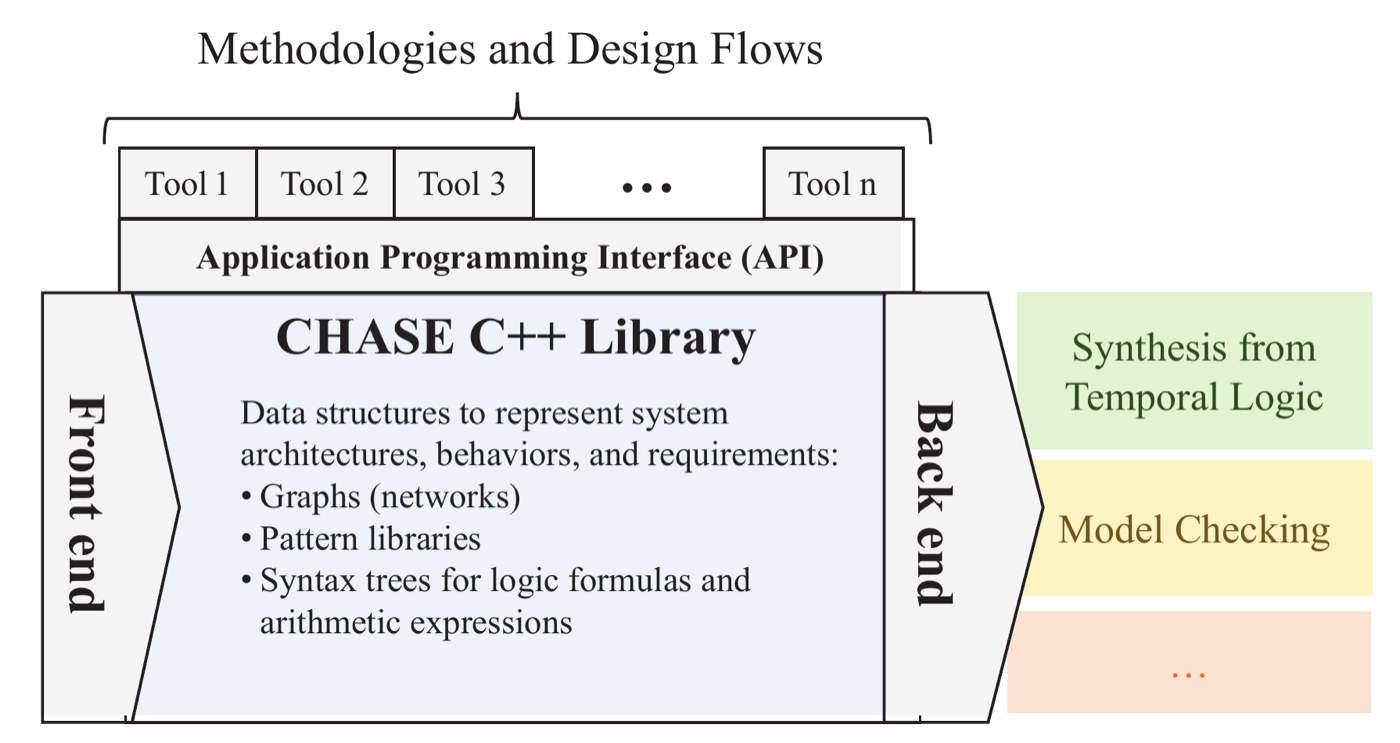
The front-end modules parse the specification languages and build the CHASE representation of a design problem. The CHASE libraries represent and manipulate systems, behaviors, and contracts. The back-end modules translate the problems into the languages of verification and synthesis tools.
Quick start
The chase repository is the entry point to CHASE: it collects all the modules and builds them at once. The complete CHASE toolchain, including the gr1c, slugs, and nuXmv solvers, is available as a Docker image (nuXmv is free for academic and non-commercial use, and installed only when its license is accepted):
$>  git clone --recursive https://github.com/chase-cps/chase
$>  cd chase
$>  docker build --build-arg ACCEPT_NUXMV_LICENSE=yes -t chase .
$>  docker run --rm -it chase
The container starts in the demos directory. To build CHASE from sources, see Requirements and Installation.
Python package
The chase_cps Python package provides contracts written in the standard LTL
syntax, the contract algebra of CHASE (composition, conjunction, merging,
quotient, separation, saturation, simplification), and refinement,
consistency, compatibility, and realizability checks with nuXmv and slugs. A failed check returns a counterexample trace.
$> pip install chase-cps
The checks need nuXmv, and slugs for realizability, installed separately
with chase-cps install nuxmv --accept-license and chase-cps install slugs
(or by hand); chase-cps doctor shows
the tools found, and chase-cps check specs.ltl checks the contracts of a
specification from the command line.
from chase_cps import Contract, refines

spec = Contract.from_strings(inputs=["req"], outputs=["grant"],
                             assumptions=["G F !req"],
                             guarantees=["G (req -> F grant)"], name="Spec")
impl = Contract.from_strings(inputs=["req"], outputs=["grant"],
                             guarantees=["G (req -> X grant)"], name="Impl")
print(refines(impl, spec).status)
Publications
CHASE has been presented at the IEEE/ACM Design, Automation and Test in Europe (DATE) conference 2018
Pierluigi Nuzzo, Michele Lora, Yishai Feldman, Alberto Sangiovanni-Vincentelli, “CHASE: Contract-Based Requirement Engineering for Cyber-Physical System Design”
To cite CHASE in an academic work, please use the following bibtex entry:
@inproceedings{CHASE:2018:DATE,
  title={CHASE: Contract-based requirement engineering for cyber-physical system design},
  author={Nuzzo, Pierluigi and Lora, Michele and Feldman, Yishai A and Sangiovanni-Vincentelli, Alberto L},
  booktitle={Proceedings of the Design, Automation \& Test in Europe Conference \& Exhibition (DATE) 2018},
  pages={839--844},
  year={2018},
  organization={IEEE}
}
The DATE18 directory of the demos repository contains the specification files used in the experimental section of the paper.
Other publications
- Michele Lora, Pierluigi Nuzzo, “A Contract-Based Requirement Engineering Framework for the Design of Industrial Cyber-Physical Systems”, Work-in-Progress, ACM/IEEE International Conference on Cyber-Physical Systems (ICCPS), 2022, developed within the DeFacto project. PDF
CHASE components and repositories
CHASE is organized in the following components, available at the corresponding repositories:
- chase: the entry point, collecting all the components as git
submodules, with the scripts to build and install them, the Docker image,
and the Python package.
Link to the repository - core-library (mandatory): the library providing the classes and structures
required to represent design problems and systems using CHASE. It also
provides a set of utility classes, functions, and methods to manipulate
CHASE-based representations, and their Python bindings. It is the main
component of the CHASE framework.
Link to the repository - chase-backends: collection of backends encoding CHASE problems into
different external tools, i.e., Slugs, GR1C, the SMV language of nuXmv,
and PySTL.
Link to the repository - DSL_tool: tool using a Domain Specific Language to specify discrete
timed problems defined over architectures modeled using graphs.
Link to the repository - logics_tool: tool providing a console to manipulate assume-guarantee
contracts expressed using a logics-based language.
Link to the repository - third_party: third-party libraries required to build CHASE (ANTLR4 C++
runtime).
Link to the repository - demos: demonstrations and benchmarks of CHASE (DATE 2018, DATE 2021
University Booth, CPS-IoT Week 2022, FDL 2024).
Link to the repository
Index
Acknowledgement
We acknowledge the support of the National Science Foundation (awards 1846524 and 2139982), the Office of Naval Research (award N00014-20-1-2258), the Defense Advanced Research Projects Agency (award HR00112010003), the Okawa Foundation, and the European Union’s Horizon 2020 research and innovation program under the Marie Sklodowska-Curie grant agreement No. 894237.